Some video games make millions, dominate the headlines, attract enormous communities, and then disappear almost as quickly as they arrived. Others survive for a few years before their developers shut down the servers and move on to something new. But somewhere in the history of online gaming, there is a remarkable exception that continues to challenge everything we think we know about the lifespan of a video game.
That game is MU Online.
Released in 2001, MU Online is now celebrating 25 years of existence. Its graphics belong to another generation, its gameplay mechanics are rooted in the early days of MMORPGs, and its classic visual identity remains instantly recognizable. Yet while countless newer online games have come and gone, MU Online continues to attract players, receive updates, and inspire new communities around the world.
Perhaps even more surprising is what happened outside the official game. An entire ecosystem of MU Online private servers developed over the years, allowing players to experience different versions of the game, revisit classic seasons, and compete under completely different progression systems.
And in November 2026, another ambitious chapter of this unusual gaming story is about to begin.
The MMORPG That Started Everything for a Generation of Players
To understand the extraordinary survival of MuOnline, we need to travel back to 2001, when South Korean developer Webzen introduced a fantasy MMORPG that would eventually become a recognizable name in online gaming communities across multiple continents.
The internet was a very different place. Online gaming was still developing, social media as we know it did not exist, and multiplayer experiences felt like a genuine technological adventure. Connecting to a virtual world populated by real people was enough to create a sense of excitement that modern players sometimes take for granted.
MU Online offered exactly that experience. It presented a dark fantasy continent filled with dangerous monsters, mysterious locations, powerful equipment, and other players pursuing the same objective: becoming stronger.
The game initially gained recognition in South Korea before expanding into international markets, including China, Taiwan, Japan, and other parts of Asia. Over time, it also developed dedicated communities in Europe, Latin America, and beyond.
It is difficult to imagine that anyone involved in those early years could have confidently predicted what would happen next. A game created at the beginning of the millennium would still have an active following a quarter of a century later, long after the technology and gaming industry around it had transformed.
What Is MU Online and Why Did Players Become So Addicted to It?
At its core, MU Online is a three-dimensional fantasy MMORPG built around character progression, monster hunting, equipment upgrades, and interaction with other players. Its basic concept is simple enough for a newcomer to understand, yet reaching the highest levels of progression can demand considerable time, knowledge, and dedication.
Players choose a character class, defeat monsters to earn experience, distribute attribute points, collect equipment, and gradually explore more dangerous areas. Classic characters such as Dark Knight, Dark Wizard, and Fairy Elf became symbols of the game, with additional classes introduced through later updates.
Locations like Lorencia, Noria, Devias, Dungeon, Lost Tower, Atlans, and Icarus became familiar meeting points and battlegrounds for millions of adventures over the game’s lifetime.
But the real attraction was never simply killing monsters.
It was the constant possibility that the next monster could drop something extraordinary.
A valuable Jewel of Bless, a rare Excellent item, a powerful weapon, or an upgrade that transformed an ordinary character into a feared opponent could change a player’s entire experience. Upgrading equipment involved risk, and obtaining something exceptional often required patience rather than instant gratification.
Then there was the social element. Guilds fought for influence, players traded valuable items, friendships formed during endless leveling sessions, and rivalries developed over contested hunting spots. Events such as Blood Castle, Devil Square, Chaos Castle, and Castle Siege gave players reasons to cooperate or compete beyond ordinary character progression.
In many ways, MU Online succeeded because it understood a fundamental principle of MMORPG design: progression feels meaningful when rewards are difficult to obtain.
The Graphics Are Old. The Gameplay Is Old. So Why Is MU Online Still Popular?
Imagine showing MU Online to someone who has spent the last decade playing visually spectacular games developed with modern graphics technology. The difference would be immediate. Character animations, environments, visual effects, and interface design clearly reflect the game’s origins.
Unlike franchises repeatedly rebuilt around completely new visual identities, classic MuOnline remains closely associated with the distinctive look and gameplay established many years ago. The game has evolved through numerous seasons and content updates, but its familiar fantasy atmosphere has never depended on becoming a modern graphical showcase.
And strangely enough, that is part of its appeal.
Players who return to MU Online are rarely looking for photorealistic environments. They remember the sound of an item dropping, the excitement of creating their first wings, the danger of entering a difficult map, and the satisfaction of finally acquiring equipment they had pursued for weeks.
Modern games frequently attempt to hold attention with enormous open worlds, cinematic storytelling, seasonal content, and sophisticated progression systems. MU Online approaches engagement from a different direction. Its gameplay is repetitive, sometimes unforgiving, and frequently demanding, yet that repetition creates recognizable routines and long-term objectives.
For dedicated players, MU Online is not necessarily competing against the latest technological achievements. It is competing for something much more personal: their time, memories, friendships, and desire to achieve something difficult.
That emotional connection cannot simply be recreated with a better graphics engine.
MU Online Private Servers Became a Phenomenon of Their Own
One of the most fascinating developments in the history of MU Online is the rise of the private server community.
While the official game continued evolving through new seasons, character classes, maps, and increasingly complex systems, many players developed a preference for specific earlier versions. Some wanted the simplicity of classic MU Online, while others wanted faster progression, custom mechanics, more competitive PvP, or a significantly harder experience.
MU Online private servers offered precisely this variety.
Instead of following a single official progression model, independently operated servers could experiment with experience rates, item drop probabilities, reset systems, custom equipment, economic rules, and gameplay events. A player interested in rapid advancement might choose an extremely high-rate server, while someone seeking a traditional MMORPG challenge could select an x5 or similarly demanding environment.
This flexibility helped create a diverse international MuOnline private server scene. Different communities formed around different versions of the game, particularly classic seasons that continue to generate interest long after their original release.
Of course, private servers have their own challenges. Projects can disappear, player populations fluctuate, and long-term stability depends heavily on the people operating them. Finding a reliable MU Online private server requires looking beyond flashy advertisements and impressive promises.
Nevertheless, the continued existence of this independent ecosystem illustrates something remarkable. Players are not merely consuming a game developed 25 years ago. They are actively reshaping how they want to experience it.
In some communities, discussing the next private server opening generates more excitement than discussing the latest official update. That does not establish that private servers have more players than the official game, but it demonstrates how important they have become to the culture surrounding MU Online.
In 2026, MU Online Is Still Moving Forward
The idea that MU Online is simply an abandoned relic does not match reality. Its official version continues to receive new content, including the Season 21-1 updates released during 2026, while independent communities remain active around both older and newer versions.
That creates an unusual situation in the MMORPG industry. Someone discovering MU Online today can encounter a modern official version with years of accumulated content, or a classic-style experience built around the mechanics that made the game famous in the first place.
Not every returning player wants to rediscover an entirely unfamiliar progression system. Some remember Season 6 as the perfect balance between the traditional MU Online atmosphere and the introduction of additional classes, features, and competitive possibilities.
This demand for familiar gameplay with carefully selected improvements is one reason new private MU Online server projects continue to emerge.
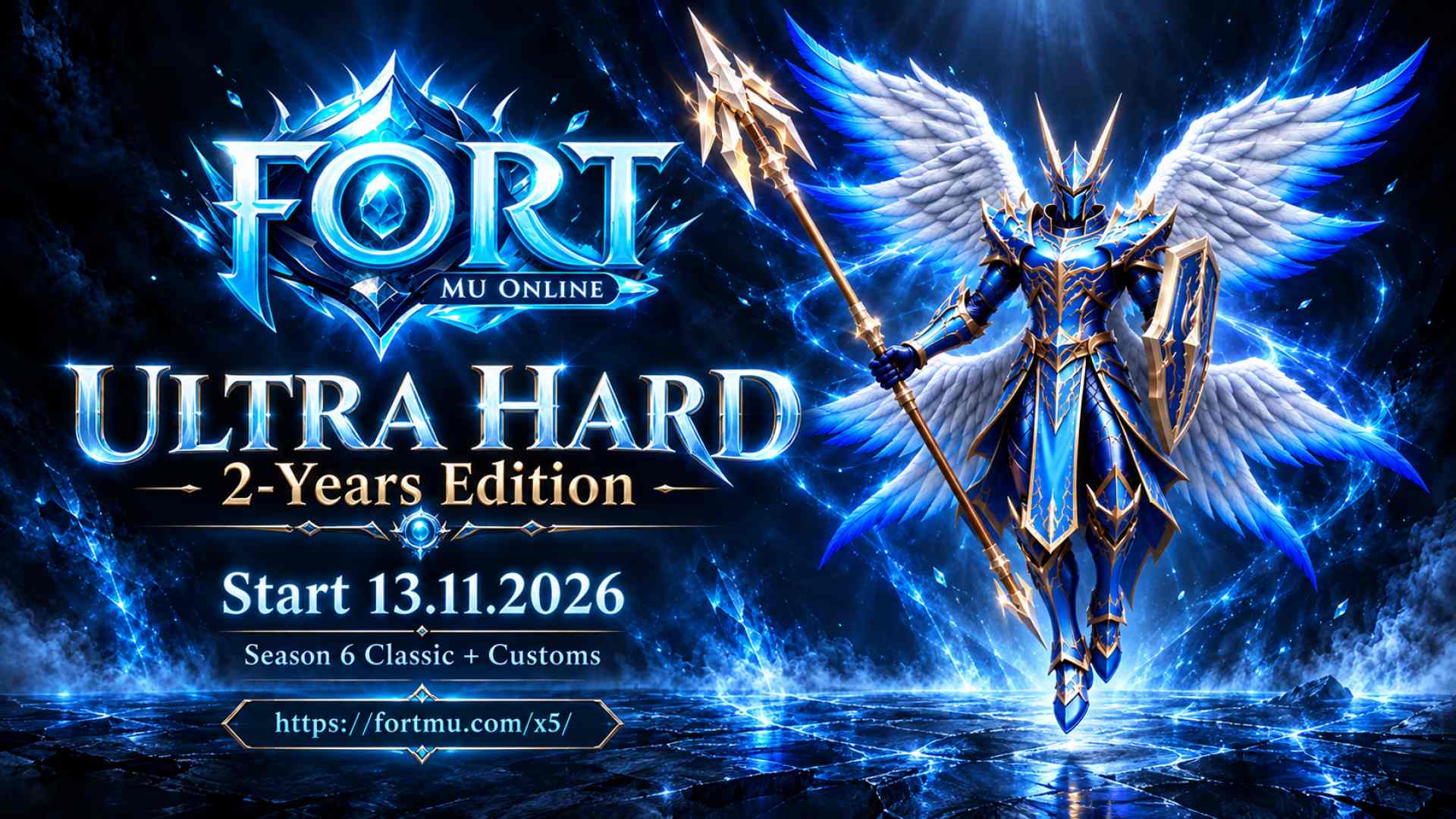
And one of those projects is preparing to open its doors on November 13, 2026.
FORT MU Is Bringing Back the Ultra Hard MU Online Experience
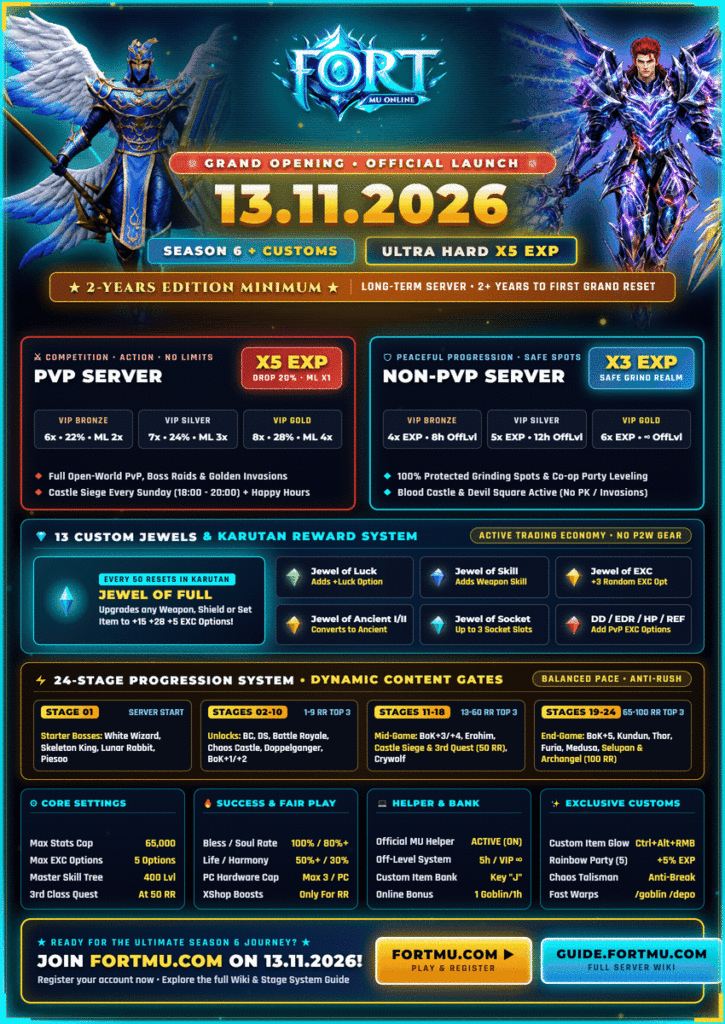
Among the upcoming MU Online private server launches, FORT MU is preparing its sixth edition, based on the popular Season 6 Episode 3 experience with additional custom systems.
The official grand opening is scheduled for November 13, 2026, at 18:00 Polish time. Rather than offering an environment where players can reach the endgame within a few days, FORT MU is designed around long-term character development, competition, and a planned two-year edition.
The core settings reflect that philosophy. Experience is set to x5 for standard gameplay, the base monster item drop rate is 20%, and the progression system includes a maximum of 400 resets. Reset cooldowns restrict how quickly characters can advance, creating a more controlled competition where time and consistency matter.
The server also introduces a stage-based progression system, additional custom jewels, challenging bosses, unique gameplay mechanics, and special long-term rewards. Every 50 resets, players can earn a Jewel of Full, a valuable item connected directly to character progression and equipment development.
Castle Siege remains an important part of the competitive experience, while a separate Non-PvP subserver offers an alternative for players who prefer safer hunting conditions, with different experience rates and restrictions.
The intention is not to replace everything that made classic MU Online memorable. It is to preserve that recognizable foundation while introducing carefully structured objectives that can remain relevant over an extended period.
For players searching for a MuOnline private server where progression is a serious commitment rather than a weekend activity, FORT MU represents a deliberately demanding option.
The complete server configuration is available in the FORT MU official guide, while accounts and the game client can be accessed through FORTMU.COM.
Perhaps MU Online Was Never Supposed to Last This Long
There is something almost impossible to explain about the survival of certain online games. Technology improves, expectations change, entire gaming genres rise and fall, and players constantly search for the next major release.
Yet MU Online continues to occupy a place in the lives of people who discovered it years or even decades ago. Some return for nostalgia, others for competition, and some are discovering the continent of MU for the very first time.
The original developers created a fantasy MMORPG. What followed was something larger: an international gaming culture built around shared experiences, familiar locations, competitive ambition, and communities that refused to let the world disappear.
Twenty-five years later, MU Online is still here. Official updates continue, private servers keep reinventing the experience, and new generations of players are still finding reasons to enter Lorencia.
On November 13, another group of adventurers will begin that journey when the sixth edition of FORT MU opens its gates.
Perhaps the greatest achievement of MU Online is not that it survived for 25 years. It is that, after all this time, people are still excited to start again from level one.